Background:
CD80 Antibody: CD80, also known as B7-1, is a type I membrane protein that is a member of the immunoglobulin superfamily. Like the related protein CD86, this protein is expressed by antigen-presenting cells, and is the ligand for two proteins at the cell surface of T cells, CD28 and the cytotoxic T-lymphocyte-associated protein 4 (CTLA-4). Binding of this protein with CD28 antigen is a costimulatory signal for activation of the T-cell and induces T-cell proliferation and cytokine production. CTLA-4 binding negatively regulates T-cell activation and diminishes the immune response (1). Blocking the CTLA-4-CD80/CD86 interaction has been shown to enhance T-cell functions in acute lymphoblastomic leukemia (ALL), suggesting that this pathway may be an attractive target for future cancer immunotherapy (2).
![CD80 Antibody [11D1]](https://www.prosciantibodies.com/wp-content/uploads/2021/11/CD80-Antibody-11D1_ICC_RF16044.gif)
![CD80 Antibody [11D1]](https://www.prosciantibodies.com/wp-content/uploads/2021/11/CD80-Antibody-11D1_IF_RF16044.gif)
![CD80 Antibody [11D1]](https://www.prosciantibodies.com/wp-content/uploads/2021/11/CD80-Antibody-11D1_IF-2_RF16044.gif)
![CD80 Antibody [11D1]](https://www.prosciantibodies.com/wp-content/uploads/2021/11/CD80-Antibody-11D1_IF-3_RF16044.gif)
![CD80 Antibody [11D1]](https://www.prosciantibodies.com/wp-content/uploads/2021/11/CD80-Antibody-11D1_IHC_RF16044.gif)
![CD80 Antibody [11D1]](https://www.prosciantibodies.com/wp-content/uploads/2021/11/CD80-Antibody-11D1_IHC-2_RF16044.gif)
![CD80 Antibody [11D1]](https://www.prosciantibodies.com/wp-content/uploads/2021/11/CD80-Antibody-11D1_Flow_RF16044.gif)
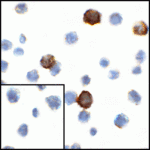
![Immunofluorescence of CD80 in transfected HEK293 cells with CD80 antibody at 2 μg/mL. <br><br>Red: CD80 Antibody [11D1] (RF16044) <br> Blue: DAPI staining](https://www.prosciantibodies.com/wp-content/uploads/2021/11/CD80-Antibody-11D1_IF_RF16044-150x150.gif)
![Immunofluorescence of CD80 in human stomach carcinoma tissue with CD80 antibody at 20 μg/mL. <br><br>Red: CD80 Antibody [11D1] (RF16044) <br> Blue: DAPI staining](https://www.prosciantibodies.com/wp-content/uploads/2021/11/CD80-Antibody-11D1_IF-2_RF16044-150x150.gif)
![Immunofluorescence of CD80 in human tonsil tissue with CD80 antibody at 2 μg/mL. <br><br>Red: CD80 Antibody [11D1] (RF16044) <br> Blue: DAPI staining](https://www.prosciantibodies.com/wp-content/uploads/2021/11/CD80-Antibody-11D1_IF-3_RF16044-150x150.gif)
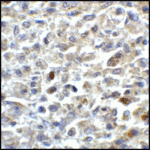
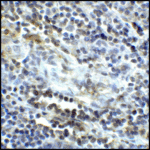
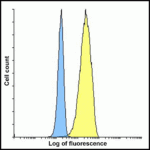
![HIV-1 p24 Antibody [9D2F6] (HRP)](https://www.prosciantibodies.com/wp-content/uploads/2023/04/HIV-1-p24-Antibody-9D2F6_WB_PM-7369-139x300.gif)
![HIV-1 p24 Antibody [9D2F6] (biotin)](https://www.prosciantibodies.com/wp-content/uploads/2023/01/HIV-1-p24-Antibody-9D2F6_WB_PM-7369.gif)
![HIV-1 p24 Antibody [9D2F6]](https://www.prosciantibodies.com/wp-content/uploads/2022/09/HIV-1-p24-Antibody-9D2F6_WB_PM-7369-139x300.gif)