Western blot analysis of CTLA-4 in overexpressing HEK293 cells CTLA-4 antibody at 0.5 and 1 μg/mL.
Trial Size
CTLA4 Antibody [2G10]
CATALOG NUMBER: RF16012
Clonality:
Monoclonal
Tested Applications:
ELISA, ICC, IF, IHC-P, WB
Host Species:
Mouse
Species Reactivity:
Human
Conjugate:
Unconjugated
Specifications
Host Species:
Mouse
Species Reactivity:
Human
Immunogen:
CTLA-4 antibody was raised against the extracellular domain of human CTLA-4.
Conjugate:
Unconjugated
Tested Applications:
ELISA, ICC, IF, IHC-P, WB
Application Note:
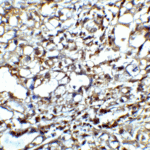
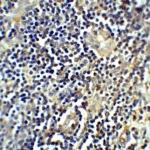
CTLA-4 antibody can be used for detection of CTLA-4 by Western blot at 1 - 2 μg/mL. Antibody can also be used for immunohistochemistry starting at 5 μg/mL. For immunofluorescence start at 20 μg/mL. Antibody validated: Western Blot in human samples; Immunohistochemistry in human samples; Immunocytochemistry in human samples and Immunofluorescence in human samples. All other applications and species not yet tested.
Positive Control 1:
Cat. No. 1210 - HEK293 Lysate Cell Lysate
Predicted Molecular Weight:
Predicted: 25 kDa Observed: 32 kDa
Advanced Validation
Properties
Purification:
CTLA-4 Antibody is supplied as protein A purified IgG1.
Clonality:
Monoclonal
Isotype:
IgG1
physical-state:
Liquid
Buffer:
CTLA-4 Antibody is supplied in PBS containing 0.02% sodium azide and 50% glycerol.
Concentration:
1 mg/mL
Storage Conditions:
CTLA-4 antibody can be stored at 4°C for three months and -20°C, stable for up to one year. As with all antibodies care should be taken to avoid repeated freeze thaw cycles. Antibodies should not be exposed to prolonged high temperatures.
Optimal dilutions for each application to be determined by the researcher.
Background
Background:
The cytotoxic T-lymphocyte-associated protein 4 (CTLA-4), also known as CD152, is a member of the immunoglobulin superfamily that is expressed by activated T cells and transmits an inhibitory signal to T cells (1,2). Both it and the homologous T-cell co-stimulatory protein CD28 bind to CD80 (B7-H1) and CD86 (B7-H2) on antigen-presenting cells (APCs) (3). Mutations in the CTLA-4 gene have been implicated in multiple autoimmune diseases (4). CTLA-4 also functions as an immune checkpoint protein, and anti- CTLA-4 antibodies have been successfully used in the treatment of cancer (5).
Background Reference 1:
Brunet JF, Denizot F, Luciani MF, et al. A new member of the immunoglobulin superfamily--CTLA-4 . Nature 1987; 328:267–70.
Background Reference 2:
Walunas TL, Lenschow DJ, Bakker CY, et al. CTLA-4 can function as a negative regulator of T cell activation. Immunity 1994; 1:405–13.
Background Reference 3:
Harding FA, McArthur JG, Gross JA, et al. CD28-mediated signalling co-stimulates murine T cells and prevents induction of anergy in T-cell clones. Nature 1992; 356:607–9.
Background Reference 4:
Romo-Tena J, Gomez-Martin D, and Alcocer-Verela J. CTLA-4 and autoimmunity: new insights into the dual regulator of tolerance. Autoimmun. Rev. 2013; 12:117.
Optimal dilutions/concentrations should be determined by the end user. The information provided is a guideline for product use. This product is for research use only.
We use cookies on our website to give you the most relevant experience by remembering your preferences and repeat visits. By clicking “Accept”, you consent to the use of cookies.
This website uses cookies to improve your experience while you navigate through the website. Out of these, the cookies that are categorized as necessary are stored on your browser as they are essential for the working of basic functionalities of the website. We also use third-party cookies that help us analyze and understand how you use this website. These cookies will be stored in your browser only with your consent. You also have the option to opt-out of these cookies. But opting out of some of these cookies may affect your browsing experience.
Necessary cookies are absolutely essential for the website to function properly. These cookies ensure basic functionalities and security features of the website, anonymously.
Cookie
Duration
Description
cookielawinfo-checbox-analytics
11 months
This cookie is set by GDPR Cookie Consent plugin. The cookie is used to store the user consent for the cookies in the category "Analytics".
cookielawinfo-checbox-functional
11 months
The cookie is set by GDPR cookie consent to record the user consent for the cookies in the category "Functional".
cookielawinfo-checbox-others
11 months
This cookie is set by GDPR Cookie Consent plugin. The cookie is used to store the user consent for the cookies in the category "Other.
cookielawinfo-checkbox-necessary
11 months
This cookie is set by GDPR Cookie Consent plugin. The cookies is used to store the user consent for the cookies in the category "Necessary".
cookielawinfo-checkbox-performance
11 months
This cookie is set by GDPR Cookie Consent plugin. The cookie is used to store the user consent for the cookies in the category "Performance".
viewed_cookie_policy
11 months
The cookie is set by the GDPR Cookie Consent plugin and is used to store whether or not user has consented to the use of cookies. It does not store any personal data.
Functional cookies help to perform certain functionalities like sharing the content of the website on social media platforms, collect feedbacks, and other third-party features.
Performance cookies are used to understand and analyze the key performance indexes of the website which helps in delivering a better user experience for the visitors.
Analytical cookies are used to understand how visitors interact with the website. These cookies help provide information on metrics the number of visitors, bounce rate, traffic source, etc.
Advertisement cookies are used to provide visitors with relevant ads and marketing campaigns. These cookies track visitors across websites and collect information to provide customized ads.

![CTLA4 Antibody [2G10]](https://www.prosciantibodies.com/wp-content/uploads/2022/07/RF16012oem.gif)
![CTLA4 Antibody [2G10]](https://www.prosciantibodies.com/wp-content/uploads/2021/11/CTLA-4-Antibody_ICC_RF16012.gif)
![CTLA4 Antibody [2G10]](https://www.prosciantibodies.com/wp-content/uploads/2021/11/CTLA-4-2G10-Antibody_IF_RF16012.gif)
![CTLA4 Antibody [2G10]](https://www.prosciantibodies.com/wp-content/uploads/2021/11/CTLA-4-2G10-Antibody_IF-2_RF16012.gif)
![CTLA4 Antibody [2G10]](https://www.prosciantibodies.com/wp-content/uploads/2021/11/CTLA-4-2G10-Antibody_IF-3_RF16012.gif)
![CTLA4 Antibody [2G10]](https://www.prosciantibodies.com/wp-content/uploads/2021/11/CTLA-4-Antibody_IHC_RF16012.gif)
![CTLA4 Antibody [2G10]](https://www.prosciantibodies.com/wp-content/uploads/2021/11/CTLA-4-Antibody_IHC-2_RF16012.gif)
![CTLA4 Antibody [2G10]](https://www.prosciantibodies.com/wp-content/uploads/2021/11/CTLA-4-Antibody-2G10_ELISA_RF16012.gif)
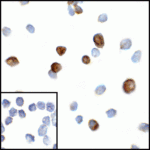
![Immunofluorescence of CTLA-4 in transfected HEK293 cells with CTLA-4 antibody at 20 μg/mL. <br><br>Red: CTLA4 Antibody [2G10] (RF16012) <br> Blue: DAPI staining](https://www.prosciantibodies.com/wp-content/uploads/2021/11/CTLA-4-2G10-Antibody_IF_RF16012-150x150.gif)
![Immunofluorescence of CTLA-4 in human lymph node tissue with CTLA-4 antibody at 20 μg/mL. <br><br>Red: CTLA4 Antibody [2G10] (RF16012) <br> Blue: DAPI staining](https://www.prosciantibodies.com/wp-content/uploads/2021/11/CTLA-4-2G10-Antibody_IF-2_RF16012-150x150.gif)
![Immunofluorescence of CTLA-4 in human tonsil tissue with CTLA-4 antibody at 20 μg/mL. <br><br>Red: CTLA4 Antibody [2G10] (RF16012) <br> Blue: DAPI staining](https://www.prosciantibodies.com/wp-content/uploads/2021/11/CTLA-4-2G10-Antibody_IF-3_RF16012-150x150.gif)
![HIV-1 p24 Antibody [9D2F6] (HRP)](https://www.prosciantibodies.com/wp-content/uploads/2023/04/HIV-1-p24-Antibody-9D2F6_WB_PM-7369-139x300.gif)
![HIV-1 p24 Antibody [9D2F6] (biotin)](https://www.prosciantibodies.com/wp-content/uploads/2023/01/HIV-1-p24-Antibody-9D2F6_WB_PM-7369.gif)
![HIV-1 p24 Antibody [9D2F6]](https://www.prosciantibodies.com/wp-content/uploads/2022/09/HIV-1-p24-Antibody-9D2F6_WB_PM-7369-139x300.gif)