
CXCL1 Antibody

CATALOG NUMBER: 31-057

Clonality:
Polyclonal
Tested Applications:
ELISA, WB
Host Species:
Rabbit
Species Reactivity:
Human
Conjugate:
Unconjugated
Specifications
Host Species:
Rabbit
Species Reactivity:
Human
Immunogen:
Antibody produced in rabbits immunized with a synthetic peptide corresponding a region of human CXCL1.
Conjugate:
Unconjugated
Tested Applications:
ELISA, WB
Application Note:
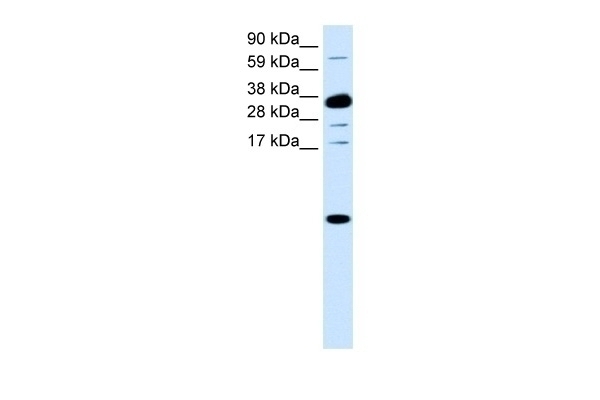
CXCL1 antibody can be used for detection of CXCL1 by ELISA at 1:312500. CXCL1 antibody can be used for detection of CXCL1 by western blot at 1 μg/mL, and HRP conjugated secondary antibody should be diluted 1:50,000 - 100,000.
Positive Control 1:
Cat. No. XBL-10420 - Fetal Small Intestine Tissue Lysate
Predicted Molecular Weight:
8 kDa
Purification:
Antibody is purified by peptide affinity chromatography method.
Clonality:
Polyclonal
Physical State:
Liquid
Buffer:
Purified antibody supplied in 1x PBS buffer with 0.09% (w/v) sodium azide and 2% sucrose.
Concentration:
batch dependent
Storage Conditions:
For short periods of storage (days) store at 4°C. For longer periods of storage, store CXCL1 antibody at -20°C. As with any antibody avoid repeat freeze-thaw cycles.
Ncbi Official Symbol:
CXCL1
Additional Names:
CXCL1, GRO1, GROa, MGSA, MGSA alpha, MGSA-a, NAP-3, SCYB1, FSP
Protein Accession Number:
NP_001502
Protein Gi Number:
4504153
Ncbi Gene Id Number:
2919
User Note:
Optimal dilutions for each application to be determined by the researcher.
Background:
Chemokines are a group of small (approximately 8 to 14 kD), mostly basic, structurally related molecules that regulate cell trafficking of various types of leukocytes through interactions with a subset of 7-transmembrane, G protein-coupled receptors. Chemokines also play fundamental roles in the development, homeostasis, and function of the immune system, and they have effects on cells of the central nervous system as well as on endothelial cells involved in angiogenesis or angiostasis. Chemokines are divided into 2 major subfamilies, CXC and CC, based on the arrangement of the first 2 of the 4 conserved cysteine residues; the 2 cysteines are separated by a single amino acid in CXC chemokines and are adjacent in CC chemokines. CXC chemokines are further subdivided into ELR and non-ELR types based on the presence or absence of a glu-leu-arg sequence adjacent and N terminal to the CXC motif.Chemokines are a group of small (approximately 8 to 14 kD), mostly basic, structurally related molecules that regulate cell trafficking of various types of leukocytes through interactions with a subset of 7-transmembrane, G protein-coupled receptors. Chemokines also play fundamental roles in the development, homeostasis, and function of the immune system, and they have effects on cells of the central nervous system as well as on endothelial cells involved in angiogenesis or angiostasis. Chemokines are divided into 2 major subfamilies, CXC and CC, based on the arrangement of the first 2 of the 4 conserved cysteine residues; the 2 cysteines are separated by a single amino acid in CXC chemokines and are adjacent in CC chemokines. CXC chemokines are further subdivided into ELR and non-ELR types based on the presence or absence of a glu-leu-arg sequence adjacent and N terminal to the CXC motif.[supplied by OMIM]. Publication Note: This RefSeq record includes a subset of the publications that are available for this gene. Please see the Entrez Gene record to access additional publications.
Background Reference 1:
Breland, U.M., (2008) Arterioscler. Thromb. Vasc. Biol. 28 (5), 1005-1011.

FOR RESEARCH USE ONLY

For additional information, visit ProSci’s Terms & Conditions Page.

Disclaimer:
This product is for research use only.

CATALOG NUMBER:

31-057

List Size:
100 ul

List Price:

$519.00

Shipping Info
Customize your order
Custom Antibody Services

New & Featured Products

CATALOG NUMBER: PM-7369-HRP

CATALOG NUMBER: PM-7369-biotin

CATALOG NUMBER: PM-7369