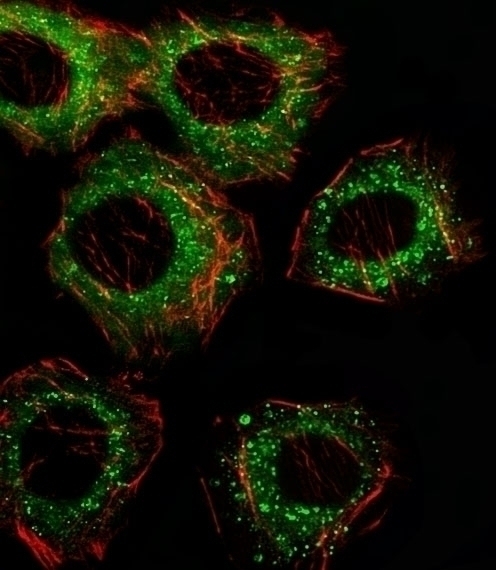
Fluorescent image of A549 cell stained with FADS2 Antibody (N-term). A549 cells were fixed with 4% PFA (20 min), permeabilized with Triton X-100 (0.1%, 10 min), then incubated with FADS2 primary antibody (1:25). For secondary antibody, Alexa Fluor 488 conjugated donkey anti-rabbit antibody (green) was used (1:400).Cytoplasmic actin was counterstained with Alexa Fluor 555 (red) conjugated Phalloidin (7units/ml).FADS2 immunoreactivity is localized to Cytoplasm and Vesicles significantly.
FADS2 Antibody
CATALOG NUMBER: 56-329
Clonality:
Polyclonal
Tested Applications:
Flow, IF, IHC-P, WB
Host Species:
Rabbit
Species Reactivity:
Human
Conjugate:
Unconjugated
Specifications
Host Species:
Rabbit
Species Reactivity:
Human
Homology:
Predicted species reactivity based on immunogen sequence: Monkey
Immunogen:
This FADS2 antibody is generated from rabbits immunized with a KLH conjugated synthetic peptide between 79-108 amino acids from the N-terminal region of human FADS2.
Conjugate:
Unconjugated
Tested Applications:
Flow, IF, IHC-P, WB
Application Note:
For IF starting dilution is: 1:10~50 For WB starting dilution is: 1:1000 For IHC-P starting dilution is: 1:10~50 For FACS starting dilution is: 1:10~50
Predicted Molecular Weight:
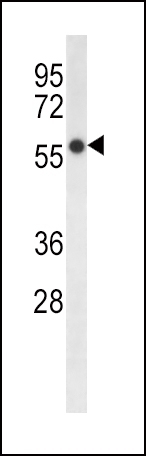
52 kDa
Advanced Validation
Properties
Purification:
This antibody is purified through a protein A column, followed by peptide affinity purification.
Clonality:
Polyclonal
Isotype:
Rabbit Ig
Physical State:
Liquid
Buffer:
Supplied in PBS with 0.09% (W/V) sodium azide.
Concentration:
batch dependent
Storage Conditions:
Store at 4°C for three months and -20°C, stable for up to one year. As with all antibodies care should be taken to avoid repeated freeze thaw cycles. Antibodies should not be exposed to prolonged high temperatures.
Optimal dilutions for each application to be determined by the researcher.
Background
Background:
The protein encoded by this gene is a member of the fattyacid desaturase (FADS) gene family. Desaturase enzymes regulateunsaturation of fatty acids through the introduction of doublebonds between defined carbons of the fatty acyl chain. FADS familymembers are considered fusion products composed of an N-terminalcytochrome b5-like domain and a C-terminal multiplemembrane-spanning desaturase portion, both of which arecharacterized by conserved histidine motifs. This gene is clusteredwith family members FADS1 and FADS2 at 11q12-q13.1; this cluster isthought to have arisen evolutionarily from gene duplication basedon its similar exon/intron organization.
Background Reference 1:
Bailey, S.D., et al. Diabetes Care 33(10):2250-2253(2010)
Background Reference 2:
Mathias, R.A., et al. J. Lipid Res. 51(9):2766-2774(2010)
Background Reference 3:
Lu, Y., et al. Am. J. Clin. Nutr. 92(1):258-265(2010)
Optimal dilutions/concentrations should be determined by the end user. The information provided is a guideline for product use. This product is for research use only.
We use cookies on our website to give you the most relevant experience by remembering your preferences and repeat visits. By clicking “Accept”, you consent to the use of cookies.
This website uses cookies to improve your experience while you navigate through the website. Out of these, the cookies that are categorized as necessary are stored on your browser as they are essential for the working of basic functionalities of the website. We also use third-party cookies that help us analyze and understand how you use this website. These cookies will be stored in your browser only with your consent. You also have the option to opt-out of these cookies. But opting out of some of these cookies may affect your browsing experience.
Necessary cookies are absolutely essential for the website to function properly. These cookies ensure basic functionalities and security features of the website, anonymously.
Cookie
Duration
Description
cookielawinfo-checbox-analytics
11 months
This cookie is set by GDPR Cookie Consent plugin. The cookie is used to store the user consent for the cookies in the category "Analytics".
cookielawinfo-checbox-functional
11 months
The cookie is set by GDPR cookie consent to record the user consent for the cookies in the category "Functional".
cookielawinfo-checbox-others
11 months
This cookie is set by GDPR Cookie Consent plugin. The cookie is used to store the user consent for the cookies in the category "Other.
cookielawinfo-checkbox-necessary
11 months
This cookie is set by GDPR Cookie Consent plugin. The cookies is used to store the user consent for the cookies in the category "Necessary".
cookielawinfo-checkbox-performance
11 months
This cookie is set by GDPR Cookie Consent plugin. The cookie is used to store the user consent for the cookies in the category "Performance".
viewed_cookie_policy
11 months
The cookie is set by the GDPR Cookie Consent plugin and is used to store whether or not user has consented to the use of cookies. It does not store any personal data.
Functional cookies help to perform certain functionalities like sharing the content of the website on social media platforms, collect feedbacks, and other third-party features.
Performance cookies are used to understand and analyze the key performance indexes of the website which helps in delivering a better user experience for the visitors.
Analytical cookies are used to understand how visitors interact with the website. These cookies help provide information on metrics the number of visitors, bounce rate, traffic source, etc.
Advertisement cookies are used to provide visitors with relevant ads and marketing campaigns. These cookies track visitors across websites and collect information to provide customized ads.

![HIV-1 p24 Antibody [9D2F6] (HRP)](https://www.prosciantibodies.com/wp-content/uploads/2023/04/HIV-1-p24-Antibody-9D2F6_WB_PM-7369-139x300.gif)
![HIV-1 p24 Antibody [9D2F6] (biotin)](https://www.prosciantibodies.com/wp-content/uploads/2023/01/HIV-1-p24-Antibody-9D2F6_WB_PM-7369.gif)
![HIV-1 p24 Antibody [9D2F6]](https://www.prosciantibodies.com/wp-content/uploads/2022/09/HIV-1-p24-Antibody-9D2F6_WB_PM-7369-139x300.gif)