Human Noggin/NOG Recombinant Protein (85-332)

CATALOG NUMBER: 85-332

Tested Applications:
Bioactivity Test, ELISA, Immunogen, SDS-PAGE, WB
Specifications
source-species:
HEK293 cells
Species:
Human
source-species:
HEK293 cells
Recombinant Protein Sequence:
Gln28-Cys232
Fusion Tag:
C-His
Tested Applications:
Bioactivity Test, ELISA, Immunogen, SDS-PAGE, WB
Application Note:
ELISA, Immunogen, SDS-PAGE, WB, Bioactivity Test
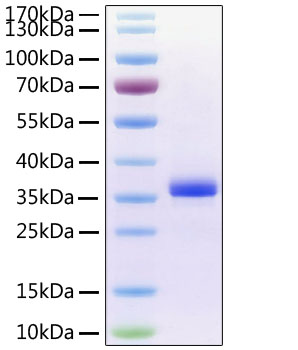
Predicted Molecular Weight:
23.89 kDa
Biological Activity:
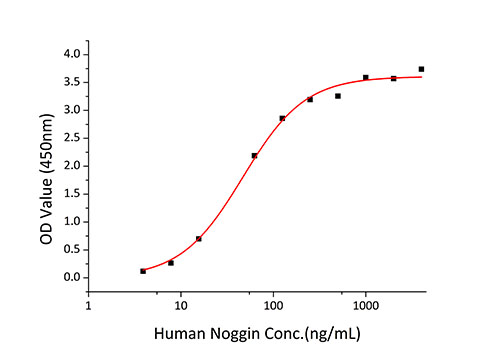
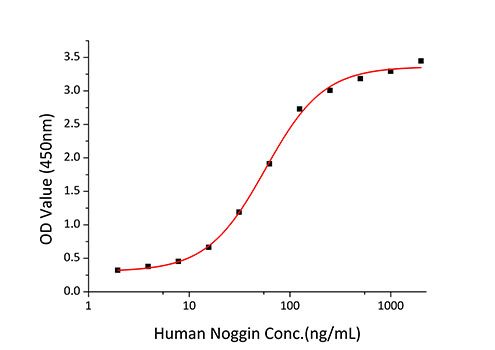
1.Measured by its binding ability in a functional ELISA. Immobilized Human BMP2 at 1 μg/mL (100 μL/well) can bind Noggin with a linear range of 2-57 ng/mL.
2. Measured by its binding ability in a functional ELISA.Immobilized Human BMP4 at 0.5 μg/mL (100 μL/well) can bind Noggin with a linear range of 4-47 ng/mL.
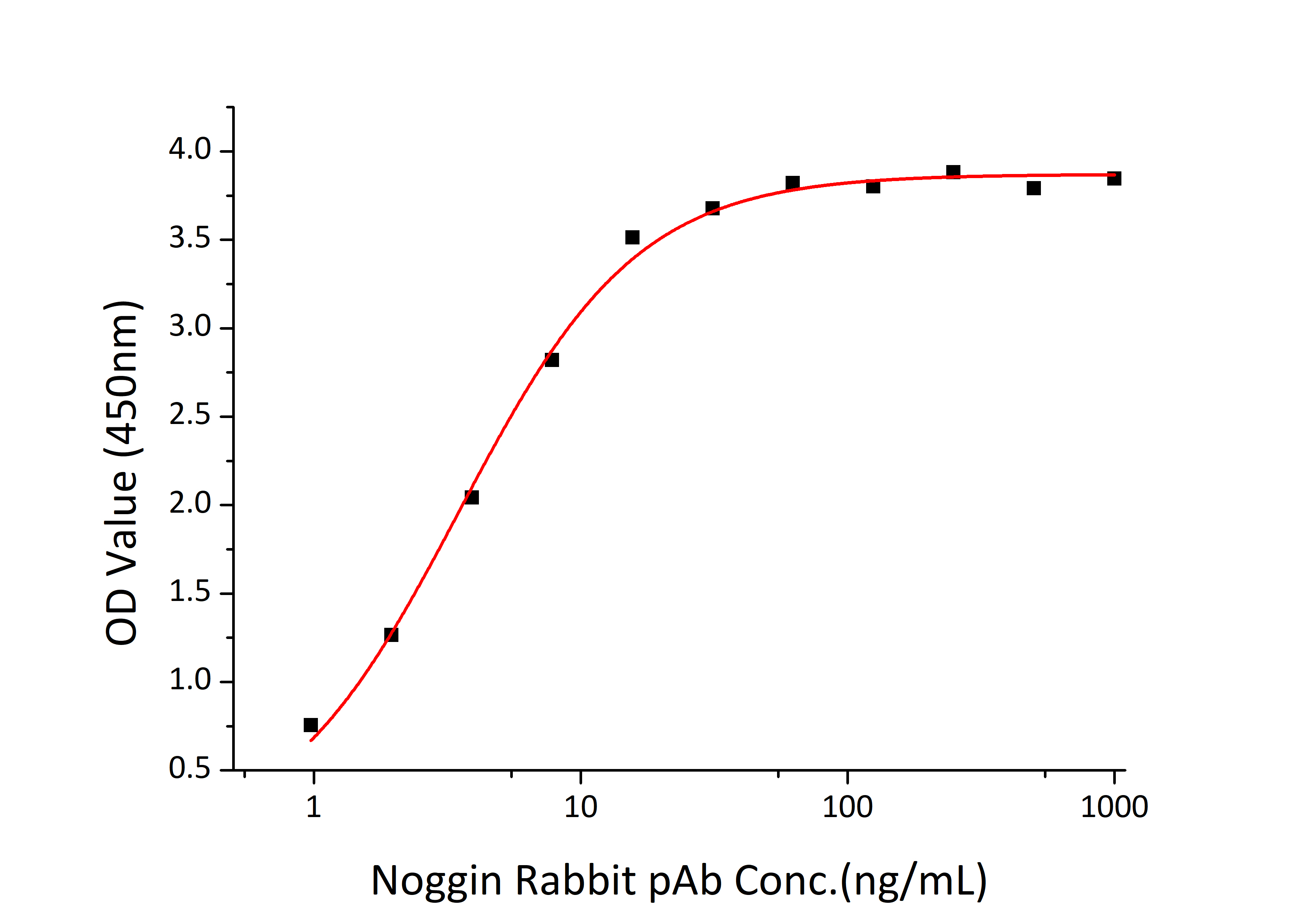
3.Measured by its binding ability in a functional ELISA. Immobilized Human Noggin at 1 μg/mL (100 μL/well) can bind Noggin Rabbit pAb with a linear range of 1-3.5 ng/mL.
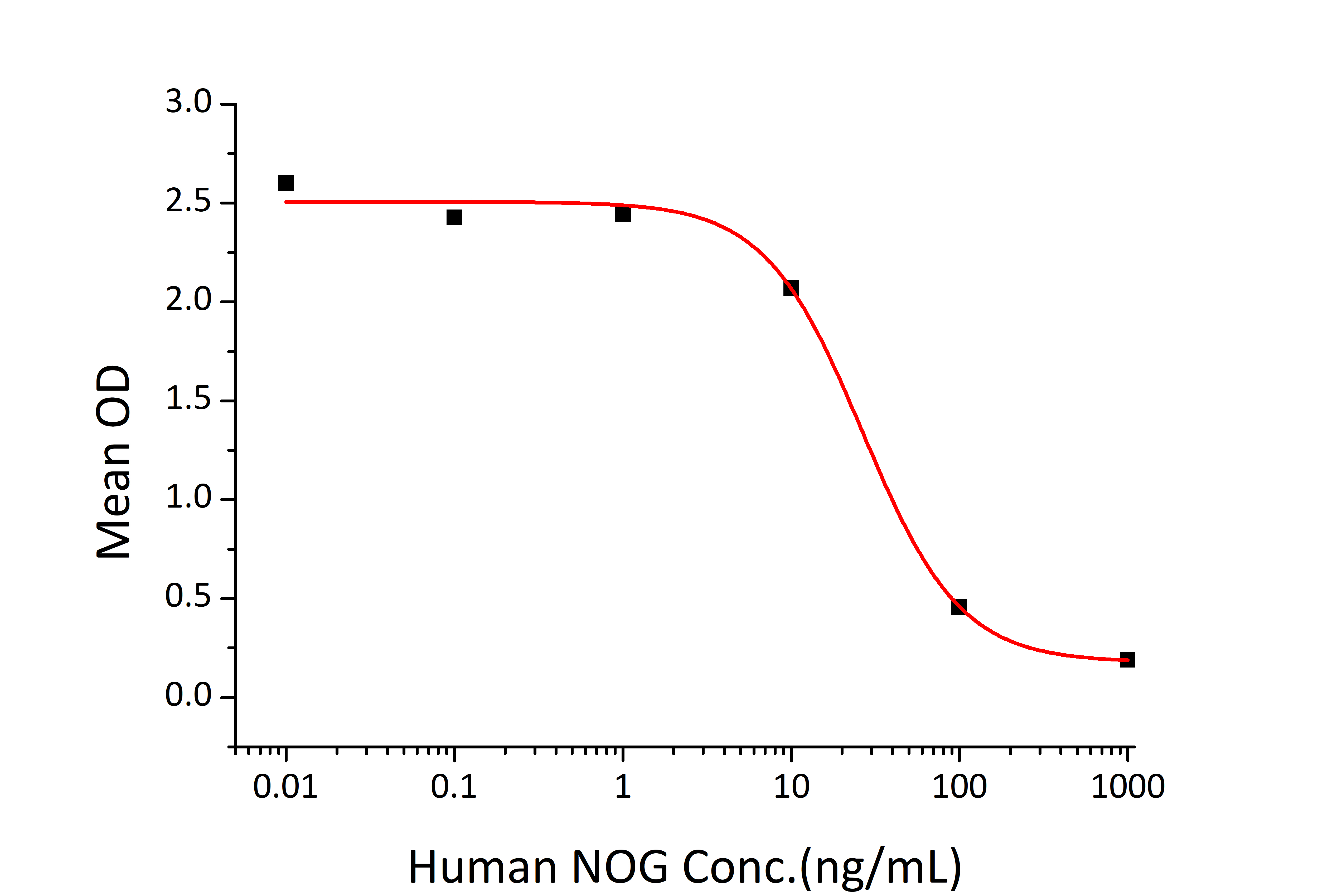
4. Measured by its ability to inhibit BMP-4-induced alkaline phosphatase production by ATDC5 mouse chondrogenic cells. The ED50 for this effect is 13.28-53.12 ng/mL in the presence of 50 ng/mL of recombinant human BMP-4, corresponding to a specific activity of 1.88×10⁴-7.53×10⁴ units/mg.
Purity:
≥ 95 % as determined by SDS-PAGE.
Endotoxin:
< 0.1 EU/μg of the protein by LAL method.
physical-state:
Lyophilized
Buffer:
Lyophilized from a 0.22 μm filtered solution of PBS, pH 7.4.Contact us for customized product form or formulation.
Storage Conditions:
Store at -20°C.Store the lyophilized protein at -20°C to -80 °C up to 1 year from the date of receipt.
After reconstitution, the protein solution is stable at -20°C for 3 months, at 2-8°C for up to 1 week.
Additional Names:
NOG,SYM1,SYNS1,SYNS1A,noggin
Protein Accession Number:
NP_005441.1
Ncbi Gene Id Number:
9241
Background:
By diffusing through extracellular matrices more efficiently than members of the TGF-beta superfamily, this protein may have a principal role in creating morphogenic gradients. The protein appears to have pleiotropic effect, both early in development as well as in later stages. It was originally isolated from Xenopus based on its ability to restore normal dorsal-ventral body axis in embryos that had been artificially ventralized by UV treatment. The results of the mouse knockout of the ortholog suggest that it is involved in numerous developmental processes, such as neural tube fusion and joint formation. Recently, several dominant human NOG mutations in unrelated families with proximal symphalangism (SYM1) and multiple synostoses syndrome (SYNS1) were identified; both SYM1 and SYNS1 have multiple joint fusion as their principal feature, and map to the same region (17q22) as this gene. All of these mutations altered evolutionarily conserved amino acid residues. The amino acid sequence of this human gene is highly homologous to that of Xenopus, rat and mouse.

FOR RESEARCH USE ONLY

For additional information, visit ProSci’s Terms & Conditions Page.

Disclaimer:
Products are intended for laboratory research purposes only and should be used by qualified personnel only. They are not intended for use in humans. ProSci is not liable for damages or injuries resulting from receipt and/or use of ProSci materials. Please refer to the Material Safety Data Sheet (MSDS) for safe storage, handling, and use procedures.

CATALOG NUMBER:

85-332

List Size:
0.01 mg, 0.05 mg

List Price:

Price range: $140.00 through $350.00

Shipping Info
Customize your order
Custom Antibody Services

New & Featured Products

CATALOG NUMBER: PM-7369-HRP

CATALOG NUMBER: PM-7369-biotin

CATALOG NUMBER: PM-7369