Background:
LIGHT Antibody: LIGHT, also known as Tumor Necrosis Factor Superfamily member 14 (TNFSF14), is a co-stimulatory molecule that can regulate T-cell activation (1) and has recently been identified as an immune checkpoint protein. LIGHT binds to two different receptors, Herpes Virus Entry Mediator (HVEM) and Lymphotoxin beta Receptor (LTβR). While LIGHT binding to HVEM delivers a co-stimulatory signal to T cells (1), LIGHT binding to LTβR is critical for the formation of lymphoid structures which can stimulate T cell infiltration and activation of a tumor microenvironment, leading to rapid T cell-mediated tissue destruction (2). It has been shown that targeted delivery of LIGHT to tumors, thereby causing the T cell infiltration of the tumor, can enhance the response of the PD-1/PD-L1 checkpoint blockade anti-cancer therapy (3), suggesting that LIGHT may become a potent tool in anti-cancer treatment.
![LIGHT Antibody [8D4]](https://www.prosciantibodies.com/wp-content/uploads/2022/07/RF16064oem.gif)
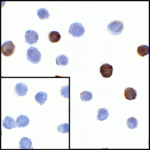
![LIGHT Antibody [8D4]](https://www.prosciantibodies.com/wp-content/uploads/2021/11/LIGHT-Antibody-8D4_ICC_RF16064.gif)
![LIGHT Antibody [8D4]](https://www.prosciantibodies.com/wp-content/uploads/2021/11/LIGHT-Antibody-8D4_IF_RF16064.gif)
![LIGHT Antibody [8D4]](https://www.prosciantibodies.com/wp-content/uploads/2021/11/LIGHT-Antibody-8D4_IF-2_RF16064.gif)
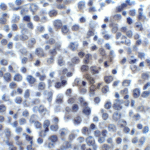
![LIGHT Antibody [8D4]](https://www.prosciantibodies.com/wp-content/uploads/2021/11/LIGHT-Antibody-8D4_IHC_RF16064.gif)
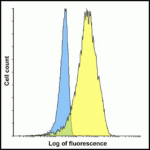
![LIGHT Antibody [8D4]](https://www.prosciantibodies.com/wp-content/uploads/2021/11/LIGHT-Antibody-8D4_FACS_RF16064.gif)
![Immunofluorescence of LIGHT in transfected HEK293 cells with LIGHT antibody at 2 μg/mL. <br><br>Green: LIGHT Antibody [8D4] (RF16064) <br> Blue: DAPI staining](https://www.prosciantibodies.com/wp-content/uploads/2021/11/LIGHT-Antibody-8D4_IF_RF16064-150x150.gif)
![Immunofluorescence of LIGHT in human lymphoma tissue with LIGHT antibody at 20 μg/mL. <br><br>Green: LIGHT Antibody [8D4] (RF16064) <br> Blue: DAPI staining](https://www.prosciantibodies.com/wp-content/uploads/2021/11/LIGHT-Antibody-8D4_IF-2_RF16064-150x150.gif)
![HIV-1 p24 Antibody [9D2F6] (HRP)](https://www.prosciantibodies.com/wp-content/uploads/2023/04/HIV-1-p24-Antibody-9D2F6_WB_PM-7369-139x300.gif)
![HIV-1 p24 Antibody [9D2F6] (biotin)](https://www.prosciantibodies.com/wp-content/uploads/2023/01/HIV-1-p24-Antibody-9D2F6_WB_PM-7369.gif)
![HIV-1 p24 Antibody [9D2F6]](https://www.prosciantibodies.com/wp-content/uploads/2022/09/HIV-1-p24-Antibody-9D2F6_WB_PM-7369-139x300.gif)