
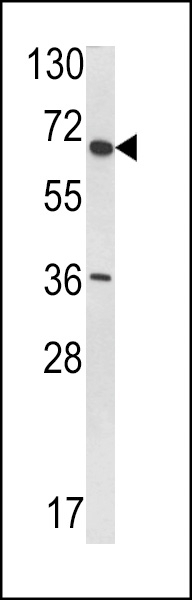
VDU1 Antibody

CATALOG NUMBER: 61-123

Clonality:
Polyclonal
Tested Applications:
WB
Host Species:
Rabbit
Species Reactivity:
Human
Conjugate:
Unconjugated
Specifications
Host Species:
Rabbit
Species Reactivity:
Human
Homology:
Predicted species reactivity based on immunogen sequence: Bovine
Immunogen:
This VDU1 antibody is generated from rabbits immunized with a KLH conjugated synthetic peptide between 799-829 amino acids from the C-terminal region of human VDU1.
Conjugate:
Unconjugated
Tested Applications:
WB
Application Note:
For WB starting dilution is: 1:1000
Predicted Molecular Weight:
107 kDa
Purification:
This antibody is prepared by Saturated Ammonium Sulfate (SAS) precipitation followed by dialysis
Clonality:
Polyclonal
Isotype:
Rabbit Ig
Physical State:
Liquid
Buffer:
Supplied in PBS with 0.09% (W/V) sodium azide.
Concentration:
batch dependent
Storage Conditions:
Store at 4°C for three months and -20°C, stable for up to one year. As with all antibodies care should be taken to avoid repeated freeze thaw cycles. Antibodies should not be exposed to prolonged high temperatures.
Ncbi Official Symbol:
USP33
Additional Names:
Ubiquitin carboxyl-terminal hydrolase 33, Deubiquitinating enzyme 33, Ubiquitin thioesterase 33, Ubiquitin-specific-processing protease 33, VHL-interacting deubiquitinating enzyme 1, hVDU1, USP33, KIAA1097, VDU1
Protein Accession Number:
Q8TEY7
Protein Gi Number:
116242838
Ncbi Gene Id Number:
23032
User Note:
Optimal dilutions for each application to be determined by the researcher.
Background:
Type 2 iodothyronine deiodinase (D2) is an integral membrane selenoenzyme that stimulates the pro-hormone thyroxine (T4) and supplies the majority of the 3,5,3?-triiodothyronine (T3) essential for brain development.1 T4 catalysis accelerates selective conjugation to ubiquitin and thereby renders D2 inactive, a posttranslational feedback mechanism used to maintain acceptable T3 levels.2,3 Ub-D2 was the first recognized substrate for von Hippel?Lindau protein?interacting (pVHL-interacting) deubiquitinating enzyme-1 (VDU1).4 VDU proteins colocalize with D2 in the endoplasmic reticulum, and their coexpression provides D2 resistance to degradation. VDU1 expression is substantially upregulated in brown adipocytes by norepinephrine or cold exposure, further amplifying D2 activity. VDU1 and VDU2 are coexpressed with D2 in many human tissues, including brain, heart, and skeletal muscle, suggesting potential roles in neurological development, cardiac function, and energy management, in addition to thermal homeostasis.VDU1- or VDU2-catalyzed deubiquitination recycles inactive Ub-D2 to its active deubiquitinated form, circumventing the proteasomal degradation pathway. Thus, Ub-D2 can be either reactivated or degraded, with the balance between these two processes influenced by VDU activity.VDU1-catalyzed D2 deubiquitination may be an important participant in the adaptive mechanism that regulates thyroid hormone action. The reversible ubiquitination-dependent mechanism regulating D2 activity permits highly responsive control of thyroid hormone activation.5,6
Background Reference 1:
Ota, T., et al., Nat. Genet. 36(1):40-45 (2004).
Background Reference 2:
Li, Z., et al., J. Biol. Chem. 277(7):4656-4662 (2002).
Background Reference 3:
Strausberg, R.L., et al., Proc. Natl. Acad. Sci. U.S.A. 99(26):16899-16903 (2002).
Background Reference 4:
Kikuno, R., et al., DNA Res. 6(3):197-205 (1999).

FOR RESEARCH USE ONLY

For additional information, visit ProSci’s Terms & Conditions Page.

Disclaimer:
Optimal dilutions/concentrations should be determined by the end user. The information provided is a guideline for product use. This product is for research use only.

CATALOG NUMBER:

61-123

List Size:
400 ul

List Price:

$495.00

Shipping Info
Customize your order
Custom Antibody Services

New & Featured Products

CATALOG NUMBER: PM-7369-HRP

CATALOG NUMBER: PM-7369-biotin

CATALOG NUMBER: PM-7369