Learn about the role of PUMA in apoptosis and cancer and how ProSci’s PUMA antibodies can aid in the study of its relationship to p53.
What is the PUMA Protein?
PUMA, also known as the p53 upregulated modulator of apoptosis, is a protein that belongs to the BCL-2 family of proteins.
It plays a critical role in the regulation of cell death and cancer development. PUMA is a pro-apoptotic protein that is activated in response to DNA damage and other cellular stress signals.
It is known to bind to and inhibit anti-apoptotic Bcl-2 proteins (Bax & Bak), thereby promoting the activation of the intrinsic apoptotic pathway. PUMA has been found to be up-regulated in a variety of cancers due to oncogenic stress, oxidative stress, and DNA damage (to name a few),(2) making it an attractive target for cancer therapy.
Why is PUMA Research Important?
The study of PUMA has gained significant attention in recent years, particularly in the field of cancer research and in mitophagy and autophagy research. The ability to accurately detect and measure PUMA levels in cells and tissues is crucial for understanding its role in cell death and its relationship to p53.
Highly Validated PUMA Antibodies from ProSci
To track and measure levels of expressed PUMA in cells, antibodies are regularly used in applications from western blot, ICC, IF, and ELISA. Of these antibodies, two popular tools used among researchers with more than 90 citations are ProSci’s PUMArabbit polyclonal antibodies (Cat No. 3041 & Cat No. 3043).
These antibody preparations have been validated for western blot, ELISA, immunocytochemistry, and immunofluorescence. They have been used in various studies to detect PUMA expression in cell lines and in primary tissues, including cancer cell lines and normal tissues.
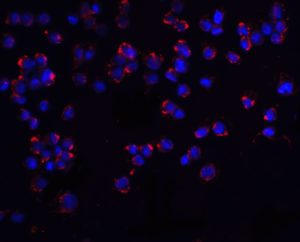
PUMA antibody (Cat. No. 3043): Immunofluorescence Validation of PUMA in K562 Cell
ProSci PUMA Antibodies: A Research Tool for Scientists
ProSci’s PUMA antibodies have been cited in many research articles in high-impact journals such as Cell Death & Disease, Journal of Neurotrauma, Frontiers in Cellular Neuroscience, and many more.
This shows how reliable and high-quality the ProSci’s PUMA antibodies are, which have become a valuable tool for researchers studying the role of PUMA in cell death and its relationship to p53.
Below are some recent studies where the antibodies have been used:
Sabirzhanov B, Matyas J, Coll-Miro M, Yu LL, Faden AI, Stoica BA, Wu J. Inhibition of microRNA-711 limits angiopoietin-1 and Akt changes, tissue damage, and motor dysfunction after contusive spinal cord injury in mice. Cell Death Dis. 2019 Nov 4;10(11):839. doi: 1038/s41419-019-2079-y. PMID: 31685802; PMCID: PMC6828685.
Sabirzhanov B, Faden AI, Aubrecht T, Henry R, Glaser E, Stoica BA. MicroRNA-711-Induced Downregulation of Angiopoietin-1 Mediates Neuronal Cell Death. J Neurotrauma. 2018 Oct 15;35(20):2462-2481. doi: 1089/neu.2017.5572. Epub 2018 Jul 10. PMID: 29774773; PMCID: PMC6196751.
Zhang Y, Yan W, Jung YS, Chen X. PUMA Cooperates with p21 to Regulate Mammary Epithelial Morphogenesis and Epithelial-To-Mesenchymal Transition. PLoS One. 2013 Jun 21;8(6):e66464. doi: 1371/journal.pone.0066464. Erratum in: PLoS One. 2020 Aug 7;15(8):e0237624. PMID: 23805223; PMCID: PMC3689819.
We use cookies on our website to give you the most relevant experience by remembering your preferences and repeat visits. By clicking “Accept”, you consent to the use of cookies.
This website uses cookies to improve your experience while you navigate through the website. Out of these, the cookies that are categorized as necessary are stored on your browser as they are essential for the working of basic functionalities of the website. We also use third-party cookies that help us analyze and understand how you use this website. These cookies will be stored in your browser only with your consent. You also have the option to opt-out of these cookies. But opting out of some of these cookies may affect your browsing experience.
Necessary cookies are absolutely essential for the website to function properly. These cookies ensure basic functionalities and security features of the website, anonymously.
Cookie
Duration
Description
cookielawinfo-checbox-analytics
11 months
This cookie is set by GDPR Cookie Consent plugin. The cookie is used to store the user consent for the cookies in the category "Analytics".
cookielawinfo-checbox-functional
11 months
The cookie is set by GDPR cookie consent to record the user consent for the cookies in the category "Functional".
cookielawinfo-checbox-others
11 months
This cookie is set by GDPR Cookie Consent plugin. The cookie is used to store the user consent for the cookies in the category "Other.
cookielawinfo-checkbox-necessary
11 months
This cookie is set by GDPR Cookie Consent plugin. The cookies is used to store the user consent for the cookies in the category "Necessary".
cookielawinfo-checkbox-performance
11 months
This cookie is set by GDPR Cookie Consent plugin. The cookie is used to store the user consent for the cookies in the category "Performance".
viewed_cookie_policy
11 months
The cookie is set by the GDPR Cookie Consent plugin and is used to store whether or not user has consented to the use of cookies. It does not store any personal data.
Functional cookies help to perform certain functionalities like sharing the content of the website on social media platforms, collect feedbacks, and other third-party features.
Performance cookies are used to understand and analyze the key performance indexes of the website which helps in delivering a better user experience for the visitors.
Analytical cookies are used to understand how visitors interact with the website. These cookies help provide information on metrics the number of visitors, bounce rate, traffic source, etc.
Advertisement cookies are used to provide visitors with relevant ads and marketing campaigns. These cookies track visitors across websites and collect information to provide customized ads.