
What is an inflammasome?
An inflammasome is a formation of danger-sensing proteins when a cell becomes infected or damaged and is typically there to regulate the activation of caspase-1 and activate inflammation when host proteins create infectious microbes and molecules.
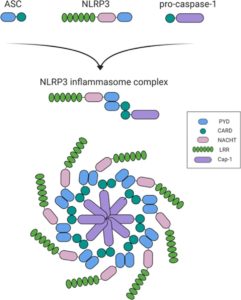
As mentioned above, one of many functions is to detect and sense the presence of various endogenous or exogenous, sterile, or infectious stimuli that are encountered within a cell.
Jürg Tschopp, at the University of Lausanne 2002, stated that inflammasomes were recognized to play a key role in diseases such as Type 2 Diabetes and Gout (1, 2). Inflammasomes have since been shown to play an important part in the Innate Immune System, working as a first-line defense against pathogens and host “danger” signals.
Inflammasomes are protein complexes present in the cytosol that activate Caspase 1 (CASP1) leading to the induction of pro-inflammatory cytokines and pyroptosis (cell death) (3). The assembly of these proteins is activated by pattern recognition receptors (PRRs) responding to pathogen-associated molecular patterns (PAMPs) and danger-associated molecular patterns (DAMPs) of the host cells (4).
- Canonical Inflammasomes are typically comprised of a sensor, an adaptor protein (ASC), and pro-caspase-1. Sensors include NLRP1, NLRP3, NAIP/NLRC4, NLRP6, NLRP7, AIM2, IFI16, and Pyrin.
- The non-canonical Inflammasome pathway involves human caspases CASP4, CASP5, and their Murine orthologs CASP11 or CASP8 (5, 6).
How ProSci Supports Inflammasome Research
To support research, ProSci offers antibodies against each component of the protein complexes as well as those proteins involved in the Pyroptosis Response. View the range of reagents at ProSci.
References
- Martinon, F., Burns, K., & Tschopp, J. (2002). The Inflammasome. In Molecular Cell (Vol. 10, Issue 2, pp. 417–426). Elsevier BV. DOI: https://doi.org/10.1016/s1097-2765(02)00599-3
- Dagenais, M., Skeldon, A. & Saleh, M. The inflammasome: in memory of Dr. Jurg Tschopp. Cell Death Differ 19, 5–12 (2012). DOI: https://www.nature.com/articles/cdd2011159
- Chavarría-Smith, J., & Vance, R. E. (2015). The NLRP1 inflammasomes. In Immunological Reviews (Vol. 265, Issue 1, pp. 22–34). Wiley. https://doi.org/10.1111/imr.12283
- Broz, P., & Dixit, V. M. (2016). Inflammasomes: mechanism of assembly, regulation and signalling. In Nature Reviews Immunology (Vol. 16, Issue 7, pp. 407–420). Springer Science and Business Media LLC. https://doi.org/10.1038/nri.2016.58
- Russo, A. J., Behl, B., Banerjee, I., & Rathinam, V. A. K. (2018). Emerging Insights into Noncanonical Inflammasome Recognition of Microbes. In Journal of Molecular Biology (Vol. 430, Issue 2, pp. 207–216). Elsevier BV. https://doi.org/10.1016/j.jmb.2017.10.003
- Zheng, D., Liwinski, T., & Elinav, E. (2020). Inflammasome activation and regulation: toward a better understanding of complex mechanisms. In Cell Discovery (Vol. 6, Issue 1). Springer Science and Business Media LLC. https://doi.org/10.1038/s41421-020-0167-x
- Image from: Seok, J.K., Kang, H.C., Cho, YY. et al. Therapeutic regulation of the NLRP3 inflammasome in chronic inflammatory diseases. Arch. Pharm. Res. 44, 16–35 (2021). https://doi.org/10.1007/s12272-021-01307-9